


"Coronation" Mass by Mozart
Notes © Shulamit Hoffmann 2025
The Mass in C, KV 317, the "Coronation" Mass is the grandest and most popular of all Mozart's sacred works written in Salzburg; the Requiem and the C minor Mass being the two iconic sacred works from his Vienna period. In January 1779, Mozart returned to Salzburg, his hometown, after a disastrous eighteen-month European tour, during which he had not been able to secure a professional post; the love of his life, Aloysia Weber, had given him up for Josef Lange; and his mother had died while with him in Paris. As no other professional opportunity was forthcoming, Mozart took up a position in the service of the Archbishop of Salzburg. The instructions of his appointment were to "unbegrudgingly and with great diligence discharge his duties both in the cathedral and at court and in the chapel house, and as occasion presents, to provide the court and church with new compositions of his own creation."
At the first opportunity Mozart fulfilled this last demand by composing the "Coronation Mass." He dates his score "March 23, 1779," most likely the date of completion of the work, as was his habit, and it was probably performed for the Easter Day service on April 4, barely two weeks later. The celebratory nature of the music belies the personal disappointments that Mozart was harboring. Indeed, the piece is filled with aplomb and assurance.
Mozart himself described the task of writing a Mass in a letter: "Our church music is very different from that of Italy, all the more so since a mass with all its movements, even for the most solemn occasions when the sovereign himself reads the mass (e.g. Easter Day), must not last more than three quarters of an hour. One needs a special training for this type of composition, and it must also be a mass with all instruments—war trumpets, tympani etc."
Thus, Mozart was obliged to write in the form that was preferred by the Archbishop, a hybrid combination of the compact "Short Mass" and the instrumental grandeur of a "Solemn Mass"—horns, trumpets, and timpani. With the "Coronation Mass," Mozart's most splendid early sacred work, the young composer puts his best compositional foot forward to justify his new appointment. Not only is the music wonderful in and of itself, but the text setting and the music's capturing and reflecting both the literal meaning and the implied moods of the text is masterful.
Even as early as the nineteenth century, this Mass was already popularly referred to as the "Coronation Mass." The nickname at first grew out of the belief that Mozart had written the Mass for Salzburg's annual celebration of the crowning of the Shrine of the Virgin at the church of Maria Plain, just outside Salzburg, where a "miraculous" painting was installed. But recent scholarship suggests that certain dates do not support this theory.
The more likely explanation is that the Mass was one of the works performed during the coronation festivities in Prague, perhaps as early as August 1791 for Leopold II. Mozart had written from Prague requesting that the parts for his old Mass in C be sent to him there.
Another possibility is a posthumous performace, for Leopold's successor Francis I in August 1792. There is extant another set of parts dating from 1792 and the same parts were probably used the year before. Mozart had a more felicitous relationship with Prague than he did with Vienna, so it is not unlikely that a mass of his would be performed at a coronation ceremony in a city that so appreciated his music. in all probability, the moniker "Coronation" would have grown from there. Certainly, the music's resplendent pomp befits a coronation.
In Salzburg, the practice of mass performances for religious services included the interpolation, between the movements of the mass, not only of liturgical readings but of other short musical pieces. Under the "forty-five minutes and no more" constraints of the Archbishop, Mozart composed seventeen Church or Epistle Sonatas, each en miniature, to be inserted between Mass movements. We have adopted this practice and we have chosen Church Sonata KV 329 (317a)* to be performed between the Mass' Gloria and Credo sections. The sonata is in the same key as the "Coronation" Mass, fulsomely scored for the same instrumentation—somewhat unusual for Church music, and is thus almost certainly the one that Mozart wrote for the first performance of the
this Mass.
The Kyrie, the first movement of the Mass, opens in dignified splendor, winds and timpani punctuating the exclamations of the full chorus and the violins marching in processional, unison, dotted rhythms. With a slight shift to a more lyrical line, the soprano soloist enters, followed by the tenor, with an oboe tail-gaiting, commenting on the duet.
Opera buffs will recognize the soprano's exquisite opening phrase: more than a decade later, Mozart uses the same phrase and the same instrumental introduction, in Fiordiligi's aria, "Come scoglio" in Cosi fan Tutte. The chorus returns to close the movement with more of the majesty of the opening.

Salzburg Cathedral

Wolfgang Amadeus Mozart

Mozart Shrine of the Virgin at Maria Plain

St Vitus Cathedralin Prague
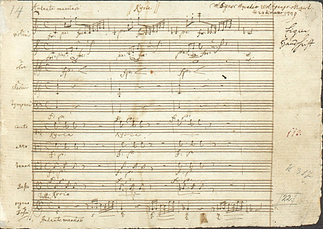
First page of the autograph manuscript of the Krönungsmesse (Coronation Mass)
The Gloria is set in sonata-allegro form, with exposition, development, and
recapitulation. It opens with ebullient joy as it expresses glory and praise of God and tenderness for "men of goodwill." In this movement, the choral statements offset the music of the four soloists, as gold or platinum settings of fine jewelry show off precious gems. There is angst and urgency in the minor key setting of "who takes away the sins of the world" and ineffable sweetness in "you alone are holy." Foregoing the customary fusty fugue, Mozart skids headlong into a closing "Amen" romp.
Now for the instrumental Epistle Sonata that we have already introduced: the piece revels in the trompetto figurations that the brass instrumentation so readily affords. Confident, ascending twirls, forteand piano, mark the first subject; the second subject, a polite discussion between strings and oboes. Mozart seems to be having such a jolly good time with strings, oboes, horns, trumpets, timpani, and organ at his command and the music unfurls exuberantly.
Back in the Mass, Mozart avoids the pitfalls of the wordy and rambling Credo text firstly by using rondo form, the recurring and reassuringly recognizable rondo subject being the music of Credo in unum Deum. Secondly, because of his virtuosic, fleet-footed setting of the text, we sing a lot of Latin in a short time! Not so easy for the chorus, mind you.
A nod of well-earned praise for the violinists, who tear through a veritable torrent of sixteenths in a style that has become known as the rauschende Violinen (rustling violins). And never was rustling more artful! After a lot of hustle and bustle the tempo slackens in the middle section for the soloists' poignant Et incarnatus est and the chorus' powerful Crucifixus. The rustling violins and the chorus return to close this, the longest and densest movement of the Mass, brilliantly, without a hint of academe and with a jubilant "Et resurrexit."
The Sanctus opens with the chorus en masse effectively conveying
the maestoso (majestic) injunction of the composer. But soon Mozart can contain his ebullience no longer, and the music breaks into a bubbling allegro gallop with shouts of "Hosanna in the highest."
The reflective mood of the Benedictus is set by the strings, in a dolce (sweet) melody that is taken over by the quartet of soloists and made into a full-bodied statement about "He who comes in the name of the Lord." But the chorus will not be left out: bursting with "Hosannas" (from the Sanctus) still to be sung, they are still full of musical beans. With a sudden shift to allegro, they interject more of these spirited, dance-like calls.
The orchestra eloquently introduces the finale, setting the stage of the Agnus Dei for the soprano soloist. Once again, Mozart, ever the opera composer, knows the potent affect and effect of his melody. This one he uses nine years later as the Countess Almaviva's aria Dove sono in The Marriage of Figaro. After the tear-inducing supernal aria, the music segues into the Dona nobis pacem.
Mozart returns to the first soprano aria of the Kyrie, setting dona nobis words to the Kyrie tune, not for any liturgical connection, but for sheer melodic beauty. This juxtaposition of two sublime arias is so rich musically and transcends the sacred-secular distinctions! After the soprano's solo the three other soloists join her for a final quartet fling. The chorus enters, enthusiastic to join the party, the tempo revs up a notch, and the finale canters home with hopeful, indeed, joyful, appeals for peace.

Click on the image above to watch
© 2012 Andrew Nethsingha's excellent notes
on Coronation Mass
on a Chandos Label, St Johns College Cambridge Recording
The dissatisfaction which Mozart felt with the artistic mediocrity of Salzburg and his intense dislike of the dictatorial ruler of his birthplace are well documented. Indeed, the Prince-Archbishop of Salzburg, Hieronymus Colloredo, was resented by many of his subjects. Colloredo’s political and ecclesiastical reforms were supported by the Imperial Court in Vienna, but were frequently met with dismay by Salzburg’s civic officials and cathedral chapter alike. Yet, the twenty-two-year-old Mozart craved a stipend and was prepared – for the time being at least– to knuckle under and take the job of Court Organist. The Archbishop was self-servingly gracious in granting Mozart a salary of 450 florins, the amount previously paid to Anton Adlgasser, Mozart’s predecessor, who had served the cathedral with distinction for over a quarter of a century and who had suffered a fatal stroke at the organ console just over a year earlier.
‘Coronation’ Mass, KV 317
Within weeks of his appointment, Mozart had composed the ‘Coronation’ Mass. He bemoaned the Archbishop’s liturgical reforms, which dictated that musical settings of the Mass should be shorter than hitherto. Mozart felt artistically compromised, although he was still able to use a full orchestra (including pairs of oboes and horns, Salzburg’s trademark three trombones to double the lower voices of the choir, and the all-important festal trumpets and drums). And without wishing to patronise the greatest composer of all time, we must acknowledge that the constraints placed on Mozart by his employer lend a thrilling incisiveness to this compact work.
The C major Mass (the eighth that Mozart had written in this key) was completed on 23 March 1779 and was first performed as part of the Easter liturgy of Salzburg Cathedral two weeks later. ‘Paschal’ Mass or ‘New Appointment’ Mass would be appropriate titles in terms of the work’s usage and genesis respectively, but as the Mass achieved renown for its performance at the Imperial Coronation in Prague in 1792 (nine months after Mozart’s death), the title ‘Coronation’ Mass stuck.
The Kyrie begins in solemn manner. The dotted rhythms, the portentous harmonies, and the resonant orchestral texture all befit a work of monumental proportions. The sudden transition to the semi-buoyant arrival of the soprano and tenor soloists is a thinly veiled compositional protest, which indicates to the listener that enforced brevity is unwelcome. Fortunately, Mozart was a more focused craftsman than he was a resentful employee, and thereafter his musical integrity won the day.
The Kyrie thus acts as a piquant, if marginally uncomfortable, introduction to the blistering Gloria. Now the Easter lights are illuminated, and the celebration of the Resurrection is in full swing. The opulence of the Gloria is unmistakable, and the alternation of the solo vocal quartet (concerto) and choir (ripieno) significantly enhances the drama of the text, which Mozart scored with operatic clarity. So the choir, for instance, forcefully praises and glorifies, while the soloists more intimately bless and worship. Such attention to textual detail would have been even more striking to worshippers in late-eighteenth-century Salzburg because of the customary spatial separation of the concerto and ripieno groups in the cathedral.
The efficiency with which Mozart treats the lengthy texts of both Gloria and Credo is impressive. Although this is born out of necessity (owing to the new requirement for shorter mass settings), Mozart developed an aesthetic that worked perfectly and is dramatically satisfying. The Credo is in rondo form, with the choir hammering out martial recitatives at the beginning, middle, and end. The text is powerfully accented, and at two points, above a dominant pedal in the relative minor (‘Dominum Jesum Christum’ and ‘cum gloria’), the strong beats are overemphasised in an audibly impatient manner; we are reminded that this music is the work of an impetuous young man.
After the choir has descended in polyphonic sequence at the words ‘descendit de caelis’, the soloists introduce a profound passage at the words ‘Et incarnatus est’. The music would have accompanied the genuflection of the entire congregation, and the theological point is well made by the sensitively changing harmonies and the wistful writing for first violins.
The choral entry at ‘Crucifixus’, underpinned, as ever, by subtle trombone doubling, prolongs the spine-tingling drama until the highly charged atmosphere is suddenly interrupted by the return of the rondo material at the moment when the text turns to the Resurrection. The soloists shimmer at ‘Et in Spiritum’, until the choir and busy violins introduce the rondo theme for the third time. The same descending sequence now carries the word ‘Amen’ and, with a loud restatement of the opening four words, the movement closes in grand style.
The triple-time Sanctus is almost terse in its predominantly syllabic presentation. The trumpets and drums provide just enough majesty, and the dotted rhythms of the string parts are just grandiloquent enough, to carry the music through to the hemiola-infused ‘Hosanna’.
Even though the Benedictus would have been separated from the Sanctus by the Consecration, the Benedictus acts as the musical resolution of the Sanctus. Gently playful violin writing heralds the entry of the solo vocal quartet, which asserts itself in quasi-operatic style. The ‘Hosanna’ breaks in, and the listener is about to feel short-changed when – with a stroke of genius on Mozart’s part – the quartet resumes its material from the Benedictus.
When the ‘Hosanna’ appears for a third time, it is difficult to listen without smiling. This is liturgical humour at its best: simultaneously crafty and craftsmanlike.
The Agnus Dei is a gift for the soprano soloist. The similarity of the melody to that of the Countess in her famous aria ‘Dove sono’ in Le nozze di Figaro (1786) is unmistakable. The alternation of plucked and bowed strings, the muted violins, the artfully scored oboes, and the sparingly used horns make this one of the most sublime sections of all church music.
There can have been no doubt in the mind of anybody who attended Mass in Salzburg Cathedral on 4 April 1779 that the Archbishop was justified in appointing Mozart to the post of Court Organist. All four soloists begin the ‘dona nobis pacem’ and are answered by the choir. That the final section uses the music from the very opening of the Mass gives perfect closure to this satisfying work.